






Issue
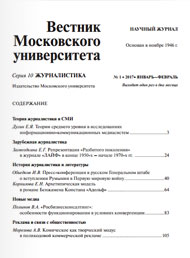
Content:
-
New Media
«Transformation of the state agenda for children’s financial literacy on a digital media platform»
This article examines the transformation of the state agenda on children’s financial literacy on the YouTube platform. The initial contradiction lies in the fact that the official strategy, aimed at fostering safe and responsible financial behaviour, is not directly reflected in media content. The aim of the study is to identify the mechanisms by which platform logic redefines the target audience, thematic structure and content formats. The theoretical framework draws on agenda-setting theory and the concept of platform logic (van Dijck, Poell, de Waal). Based on a content analysis of 691 videos (2013–2023) and ANOVA, it is shown that YouTube redefines three key parameters: the target audience (from children to parents), thematic content (from security to narratives of ‘quick enrichment’), and formats (from animation to the blogger monologue). A discrepancy is revealed: formats with the highest audience reach demonstrate the lowest engagement, while adolescents remain outside the relevant media field. A comparison of the findings with the attributes of the state strategy shows that YouTube actively transforms the agenda, replacing educational content with simplified recipes for success and risky financial attitudes.
Keywords: agenda-setting, platform logic, media, financial literacy, social policy, sociology of childhood
DOI: 10.55959/msu.vestnik.journ.4.2026.321Ekaterina S. Pilipenko 3 -
Modern Journalism: Subjects and Issues
«Dynamics of the representation of Orthodox values in Russian federal publications»
The article is devoted to an analysis of Russian federal newspapers for materials whose object is Orthodox values. The article also traces the dynamics of their representation in 2019 and 2023. The relevance of the research is related to the search by the modern Russian state for meanings uniting society. In the Russian context, it is precisely Orthodox values that can become such meanings. The main stages of the work included a theoretical understanding of the concept of Orthodox values, a content analysis of the main Russian federal publications Rossiyskaya gazeta, Komsomol’skaya pravda and Moskovskiy komsomolets for the presence of texts containing Orthodox values. The study confirmed the hypothesis of an increase in the share of publications of this type in the total number of texts in 2023 compared to 2019, due to a change in the socio-political and spiritual situation in the country, the authorities’ focus on promoting traditional, including Christian and Orthodox, values.
Keywords: traditional values, Christian values, Orthodox values, media, federal newspapers, mediatization of religion
DOI: 10.55959/msu.vestnik.journ.4.2026.2243Ekaterina A. Goryntseva, Luiza G. Svitich 22 -
«Expert assessments of Azerbaijan’s media image in Russian media»
The image of a country is usually reconstructed from media texts: a corpus of publications is subjected to content analysis, and the image is recovered from the distribution of topics and evaluations. This article reverses the optics: it examines not media texts but the assessments and interpretations of publications about Azerbaijan made by the professional community. The empirical basis comprises 18 semi-structured interviews with specialists in media, international relations and cultural diplomacy conducted in 2022, together with four interviews with participants of the first wave conducted in 2026, in which informants were presented with their own earlier judgements and asked whether these still held. The media image of Azerbaijan reveals a persistent thematic imbalance: the conflict agenda crowds out the economic, cultural and humanitarian dimensions of bilateral relations. The experts register a gap between the potential of Russian–Azerbaijani ties and their media representation, point to a shortage of intermediary structures capable of converting institutional activity into media presence, and to the underused resource of digital platforms. The repeat interviews showed that over four years not one of the identified deficits had disappeared, but that the mechanism of their reproduction had changed: editorial selection has given way to algorithmic ranking, which is resistant to the instruments of editorial policy. The resulting structure of the problem field forms a system of categories for a subsequent quantitative content analysis.
Keywords: media image of a country, mediatization, agenda-setting, framing, public diplomacy, Russian media space, Azerbaijan, expert interview
DOI: 10.55959/msu.vestnik.journ.4.2026.4457Anar M. Gasanov 44 -
Discussion
«Reportage in the age of secondary journalism»
Contemporary journalism is characterized by a secondary nature, reflecting primarily media reality rather than the immediate reality of the surrounding world. In this regard, it is particularly important to identify the place of reportage in modern media. This genre, while present in all Soviet and post-Soviet genre systems, presupposes observation of events, which is alien to modern media practices. To what extent is reportage still present in the media, and how useful is it to study reportage in publication preparation courses? To answer these questions, a study was conducted to examine the presence of reportage on the websites of the most popular Russian media outlets and identify key characteristics of the texts. It was found that half of the media outlets do not feature reportage, while another third publish it less than once a month. The sample consisted of 100 reportage pieces from 24 media outlets, with no more than five pieces per publication selected. The predominant thematic types of reportage are military and legal. Experimental, investigative and “journalist changing profession” reportage is absent. Political reportage is rare, social reportage extremely rare, critical reportage almost nonexistent, while positive reportage, which idealizes current events, accounts for more than a third. The study concludes that reportage persists in the media, but it is becoming either exotica, the result of the creativity of individual active journalists, or a propaganda tool, while complex variations of the genre have disappeared from modern Russian media.
Keywords: reportage, genres, journalistic text, online media
DOI: 10.55959/msu.vestnik.journ.4.2026.5878Alexander V. Kolesnichenko 58 -
Advertising and Public Relations
«Conceptualizing the media communication strategy of the contemporary Russian university»
The mediatization of higher education and the digital transformation of communication environments have significantly increased the strategic importance of university media communications. Contemporary universities operate as complex media actors interacting with multiple internal and external stakeholders in a highly competitive communicative environment. Despite the growing international interest in strategic communication in higher education, the university media communication strategy remains insufficiently conceptualized, particularly in Russian academic discourse. The aim of the study is to develop a preliminary conceptual model of the media communication strategy of a contemporary Russian university, drawing on theoretical analysis and empirical research. The empirical basis includes 15 expert interviews conducted in 2024–2025 with representatives of Russian universities responsible for strategic planning, information policy and media communications, and an analysis of two formalized communication documents. The sample was formed on the basis of the universities’ positions in the Media Activity Rating (M-rating) of the Russian Ministry of Science and Higher Education, geographic diversity and institutional status. The methodological framework combines strategic communication studies, mediatization theory and organizational communication; thematic analysis, comparative analysis and conceptual modeling were employed. The study proposes a preliminary conceptual model of the university media communication strategy, including conceptual, procedural, organizational, contextual and audience dimensions. Key factors influencing the effectiveness of university media communications are identified, and the specific features of strategic communication institutionalization in the Russian higher education environment are revealed. The scientific novelty lies in the conceptualization of the media communication strategy as an independent level of university strategic management and in the development of a model that systematizes the main elements of the contemporary university’s media communication activities.
Keywords: media communications, strategic communication, mediatization, university, higher education, university media communication strategy, strategic management
DOI: 10.55959/msu.vestnik.journ.4.2026.79102Anna N. Gureeva 79 -
History of Journalism
«“Okeanskiy vestnik” (“Russian East”) newspaper: typological and ideological transformations»
The article presents for the first time the history and characteristics of the newspaper Okeanskiy vestnik [Ocean Herald] (also known as Vestnik okeana and Russkiy Vostok), published in Vladivostok in 1909–1915. The sources are documents of the Russian State Historical Archive (St. Petersburg) and the Russian State Historical Archive of the Far East (Vladivostok), as well as newspaper files from libraries, archives and museums of Vladivostok. The paper shows how two local adventurers came up with the idea of becoming newspaper publishers, describes Okeanskiy vestnik under its successive owners, its place in the Vladivostok periodical system, its relations with other city publications, with the local administration and with society, and its participation in the “newspaper wars”. Survival strategies of a city newspaper in the Russian provinces in the early 20th century are revealed.
Keywords: Russian Empire, reign of Nicholas II, Vladivostok, “yellow” press, “newspaper wars”
DOI: 10.55959/msu.vestnik.journ.4.2026.103128Vadim L. Agapov 103 -
«“Radio-grams received by the local radio-station”: the formation of radio broadcasting in the Vyatka Governorate (1918–1923)»
In this work, the author addresses a little-studied period of the formation and development of radio broadcasting in the Vyatka Governorate between 1918 and 1923. Based on archival documents, the history of the emergence of the first radiotelegraph stations (receiving and receiving-transmitting) in the region and their operation is examined, clarifying dates, events, and the names of people who actively participated in this process. The author highlights the early forms of radio journalism, such as radiograms and radio bulletins, which were received by the Vyatka radio station. The scheme and features of the distribution of the poster bulletin developed in the governorate are described, as well as the role of the Vyatka Branch of ROSTA (GubROSTA) and its district branches. Some materials from the wall newspapers (poster bulletins) of the Malmyzhsky District Branch of ROSTA are introduced into scientific circulation. The first successes in mastering radiotelephone communication are noted, as well as the first experiments of collective listening to radio broadcasts from Moscow using a loudspeaker. It is concluded that the work of radiotelegraph stations in the Vyatka Governorate influenced the formation of communication infrastructure and the development of radio broadcasting in the region, which contributed to the creation of the all-Russian (all-Union) radio broadcasting network as a whole.
Keywords: Vyatka Radiotelegraph Station, radiogram, radio bulletin, poster bulletin, Vyatka Branch of ROSTA (GubROSTA)
DOI: 10.55959/msu.vestnik.journ.4.2026.129152Vadim A. Timshin 129 -
Essay
«Educational strategies for using generative artificial intelligence in journalism education»
This article presents a pedagogical reflection on three educational strategies for integrating generative artificial intelligence into journalism education. Drawing on observations of three naturally formed student groups (n = 37) across one academic semester, three distinct approaches to AI use in the classroom are described: prohibition, voluntary use, and mandatory structured integration. The study focuses on subjective educational outcomes, including changes in student motivation and the dynamics of professional identity formation in future journalists. The findings suggest that the educational impact of generative AI is shaped not by the technology itself but by the pedagogical intent guiding its use. Special attention is given to data from semi-structured interviews and students’ written self-reflections as the primary source of insight into the changes observed.
Keywords: journalism education, generative artificial intelligence, pedagogical reflection, learning motivation, professional identity, digital technologies in education
DOI: 10.55959/msu.vestnik.journ.4.2026.153170Oleg R. Samartsev 153 -
Materials, Documents, Publications
«Theses for the summary report on the survey of advertising organizations»
The publication is a document from the archival collection of the State Archive of the Russian Federation with comments from the researcher who discovered it and introduced it into scientific circulation. The document contains a description of the Soviet advertising market in the period of the 1920s. The text was created during the implementation of the New Economic Policy in the USSR. It was intended for official use and has never been published in open sources. The text is a detailed analytical note on the state of the advertising business in the USSR by the mid-1920s, prepared by the staff of the People’s Commissariat of Workers’ and Peasants’ Inspection of the USSR. This state body was engaged in auditing the activities of various institutions, enterprises, and economic sectors of the Soviet state. One of his key tasks was to identify the shortcomings of the Soviet system in order to eliminate them later. Due to this specificity, the published report is critical in nature, its authors focused on the shortcomings of the established advertising market in the USSR. The document contains general data on the structure of the Soviet advertising market, its financial turnover, the nature of the staff and other parameters. The text also provides qualitative characteristics of the industry, describes the specifics of its functioning, and highlights numerous abuses typical of advertising enterprises. The published material makes it possible to clarify many parameters not only of the Soviet advertising market, but also of the Soviet media economy as a whole.
Keywords: USSR, NEP, 1920s, advertising, advertising organizations
DOI: 10.55959/msu.vestnik.journ.4.2026.171204Maksim I. Babyuk 171 -
«“A brief report on the work of the 3rd Congress by the All-Russian Photo-Cinema Department” as a source for the early history of Soviet visual propaganda»
“A Brief Report on the Services Provided by the All-Russian Photo-Cinema Department to the Third Congress” can be regarded as an important document on the history of Soviet visual propaganda during the Great Russian Revolution (1917–1922). The document provides insight into the activities of the All-Russian Photo-Cinema Department (VFKO) on the eve of and during the Third Congress of the Comintern held in Moscow. While the VFKO’s role in the development of early Soviet cinema has repeatedly attracted the attention of researchers, far fewer scholarly articles have been written on the significance of photography in its work. The author of the document, G. M. Boltyansky, headed the VFKO’s social chronicle subdepartment during the period under study. Analysis of the source demonstrates that during the crisis when shortages of paper, photographic equipment, and photographic materials persisted, as well as problems with printing and logistics, significant efforts were made to produce and distribute visual propaganda materials (primarily photographs and cinematography) on the eve of and during the Third Congress of the Comintern. The published source contains information about the interaction of the VFKO (primarily the social news subdepartment) with other government and administrative bodies, the focus, content, specifics of distribution and recipients of materials created by the VFKO.
Keywords: G. M. Boltyansky, visual propaganda, photography, VFKO, III Congress of the Comintern
DOI: 10.55959/msu.vestnik.journ.4.2026.205215Oleg A. Bakulin 205