





Issue
№ 2
' 2026
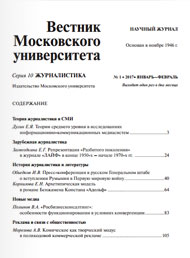
Content:
-
Media Economics
«Organization of marketing in Russian media companies: structure, tools, and effectiveness measurement practices»
The article analyzes the organization of marketing activities in Russian media companies under conditions of digital transformation. The study aims to determine how the marketing function is structured in contemporary Russian media, which tools are used in practice, how marketing effectiveness is evaluated, and what problems media professionals identify. The empirical basis consists of 80 semi-structured expert interviews conducted in 2023–2024 with representatives of federal media holdings, medium-sized national media outlets, regional media companies, niche publications, and new digital-only media projects. The findings show that 55% of the companies studied have a dedicated marketing department, 30% rely on a single in-house marketing specialist, and in 15% of cases marketing functions are distributed among editorial teams, advertising departments, or top management. The most widespread tools are social media marketing, public relations, content marketing. The study demonstrates that formal marketing planning and KPI systems are typical primarily of large media companies and fast-growing digital projects, whereas many regional media outlets still rely on situational and intuitive decision-making. More than half of the companies regularly assess the results of marketing activities, but ROI calculations are used only in a very limited number of cases. The article concludes that Russian media companies are gradually moving from intuitive promotion practices toward a more systematic and data-driven marketing model, while substantial differences between large and small market players remain.
Keywords: media marketing, marketing activities, media company, marketing communications, digital media, marketing strategy, effectiveness
DOI: 10.55959/msu.vestnik.journ.2.2026.324Taras S. Cherevko 3 -
«Media digital ecosystems as disruptive actors in the media communications industry (on the example of Yandex and VK)»
This article analyzes the transformation of the Russian media communications industry under the influence of the digital ecosystems (DES) of Yandex and VK, which are considered sources of disruptive innovation. The aim of the study is to identify the mechanisms of social, technological, and economic change initiated by these DES. The research methodology is based on a content analysis of company press releases (2010-2025) using the author’s assessment scale, adapting state technology assessment standards and international researchers’ approaches to measuring the dependence of social innovation. The results show that the development of key services of both DES is largely determined by social demands (in 68.9% of cases for VK and 52.5% for Yandex). The disruptive effect for the MCI is achieved through a comprehensive ecosystem approach that transforms market relationships, consumption patterns, and the operating principles of the entire media system. Yandex and VK are adapting to rapidly changing user needs. These companies are developing new features and platforms faster than traditional media companies, making them competitive and in demand. This creates opportunities for Yandex and VK to enter unoccupied niches and become leaders in new segments.
Keywords: media, media communications industry, media digital ecosystems, disruptive innovation
DOI: 10.55959/msu.vestnik.journ.2.2026.2550Valeria V. Kalinovskaya 25 -
Modern Journalism: Subjects and Issues
«Genre-thematic and structural-compositional aspects of information cards in Russian media»
This article examines the specificity of information cards in the Russian media space. The relevance of the study stems from the dominant position of this format in modern online media, where it is used to effectively attract audience attention in conditions of information overload. The aim of the work is a comprehensive analysis of the genre-thematic and structural-compositional features of information cards in the practice of Russian mass media. The methodology includes content analysis of 240 sets of cards from Telegram channels of eight leading Russian media outlets. The study revealed a significant evolution of the format: while genetically cards are associated with explanatory journalism and the Q&A genre, empirical data indicates a substantial expansion of functional boundaries. Modern cards are used for explanatory materials, news, practical advice, biographical essays, recipes, historical references, compilations, advertising materials, and entertainment content. Structural analysis revealed a stable core of the format: conciseness of text (20–60 words), visual richness, branding, and sequential narrative logic. The main conclusion is that information cards have transformed from a narrow specialized tool of explanatory journalism into a universal multifunctional format of digital journalism, capable of adapting to a wide range of editorial tasks.
Keywords: information cards, explanatory journalism, digital media, media formats, Telegram, content analysis, structural-compositional analysis
DOI: 10.55959/msu.vestnik.journ.2.2026.5172Ksenia A. Boldina 51 -
«The image of the teacher in the Russian socio-political press (based on publications in “Rossiyskaya Gazeta” and “Nezavisimaya Gazeta”)»
This article examines the media representation of teachers in Russian socio-political press, analyzing publications from Rossiyskaya Gazeta and Nezavisimaya Gazeta in 2010 and 2023. The study employs critical discourse analysis and framing theory as its methodological framework. A corpus of 349 publications was analyzed. Content analysis identified eight media frames that establish interpretive schemas for perceiving the teaching profession, ranging from «hero-mentor» to «object of reforms». Results demonstrate that by 2023, the state-owned outlet shifted toward a more positive representation of teachers, including portraying them as active agents; however, the proportion of materials featuring teachers’ direct speech remained unchanged (approximately 27%). The study reveals a phenomenon of «voiceless agency»: teachers are described as active professionals but rarely given the opportunity to speak for themselves.
Keywords: teacher image, socio-political press, frame, content analysis, direct speech, professional prestige
DOI: 10.55959/msu.vestnik.journ.2.2026.7396Ksenia D. Kolesnikova 73 -
Sociology of Journalism
«From idealization to pragmatism: how students in Kazakhstan choose the profession of journalism»
The article presents a comparative analysis of the value orientations, motivation and professional attitudes of students of the Faculty of Journalism in Kazakhstan based on the research conducted in 2016 and 2024. The work aims to identify the changes that have occurred in the worldview and professional selfdetermination of the young generation of journalists under the conditions of digital transformation, changes in the media landscape and socio-political dynamics. The study found that students’ value priorities have undergone significant changes due to the digitalization of society, the development of artificial intelligence, and the changing media landscape and socio-political dynamics. While in 2016, idealistic motives such as serving society, striving for truth, and influencing public consciousness dominated the choice of profession, in 2024 pragmatic guidelines come to the forefront: self-realization, autonomy, creative freedom, digital competencies and career opportunities. Additionally, the analysis highlights shifts in the perception of professional ethics, moving away from traditional moral principles towards more flexible and pragmatic approaches influenced by the digital formats of journalism and the constant pressure of the fast-paced news cycle. The results of the study suggest that today’s young journalists in Kazakhstan are in the process of developing a new professional identity that combines social responsibility with digital competencies and entrepreneurial thinking. These changes reflect the overall trends of transformation of journalism education and the role of the media in a society experiencing an era of post-industrial and technological shifts.
Keywords: journalism, values, youth, professional identity, Kazakhstan, ethics, motivation
DOI: 10.55959/msu.vestnik.journ.2.2026.97115Galiya Ibrayeva, Diana Tleugazina, Botagoz Rakisheva, Gulden Ashkenova, Leila Vasilyeva 97 -
Foreign Journalism
«The representation of artificial intelligence in China’s regional media: a comparative analysis of Dazhong Daily and Yangcheng Evening News»
This article analyzes the representation of artificial intelligence (AI) in regional media in China. The study aims to identify key themes, interpretations, and models of AI representation in two leading regional newspapers in China (Dazhong Daily, Shandong Province, and Yangcheng Evening News, Guangdong Province) and to analyze how regional media adapt the national discourse on AI to local socioeconomic conditions. The empirical base of the study consisted of 343 materials published in 2024 and selected from the electronic archives of these publications. A modified TF-IDF algorithm was used to identify thematic priorities, and the point-wise mutual information (PMI) indicator was used to analyze stable semantic relationships. A discourse analysis of a subsample of 49 materials was additionally conducted. The results reveal differences in regional models of AI representation: the Yangcheng Evening News promotes a more globally oriented technological discourse, emphasizing international technological trends and the market logic of AI development, while the Dazhong Daily interprets AI primarily as a tool for industrial modernization and the implementation of government policy. These differences reflect the specific socioeconomic and institutional development of Guangdong and Shandong provinces and highlight the importance of regional context in media discourse studies.
Keywords: artificial intelligence, China, regional media, agenda, AI discourse, discourse analysis, regional innovation systems
DOI: 10.55959/msu.vestnik.journ.2.2026.116135Olga V. Smirnova, Daniil S. Ilchenko, Ju Yunhui 116