






Issue
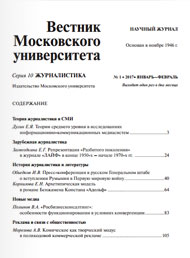
Content:
-
New Media
«Genres of publications in information Telegram channels»
The genre palette of the most popular Russian-language information Telegram channels is reduced almost exclusively to various forms of news and to “service” genres, such as announcements of publications of the “parent” media outlet and captions under illustrative content, such as photos or multimedia. A number of new, unique genres have formed in Telegram, such as an extended news summary (news supplemented with the positions of the parties, expert assessments, and background, but in a compressed form and usually without links to sources), double news (news in development of the previous news, which is laid out on top), news with an assessment (a message about an event and commenting on it in an emotional form), an extended announcement (an announcement of a publication, claiming to be self-sufficient and valuable in itself for the reader). These are the results of the study of the text part of publi cations of the 20 most popular Russian-language Telegram channels in the “News and Media” category by reach. The study also showed the absence of such traditional media genres as reportage, interview, feature, review, and column in Telegram channels. In general, it can be concluded that texts in Telegram channels are shortened and simplified compared to the media. The absence of links to sources of information and original publications has become the norm. Emotional and, at the same time, unsupported assessments of what is happening are widespread. Therefore, the media reality of Telegram risks becoming even further from reality than the media reality of the media.
Keywords: Telegram, genres, journalism, news, media
DOI: 10.55959/msu.vestnik.journ.4.2025.323Alexander V. Kolesnichenko 3 -
«Local contexts in artificial intelligence adaptation: human and machine understanding of Kazakhstani news»
The ability of generative language models to correctly adapt texts and recognize deep cultural and historical local contexts remains poorly studied. Despite the high quality of generating and translating texts, and analytical outputs, the models still demonstrate limited capabilities for interpreting socially significant meanings and values. These limits are clearly visible in current news items, where the model can produce distorted or downright erroneous interpretations. The purpose of this study is to diagnose the practical applicability of the model in adapting Kazakhstani news for an English-speaking audience unfamiliar with local realities, as well as to classify errors and inaccuracies. During the two-level analysis, the generated ChatGPT texts were compared with experts’ interpretations. In addition to assessing the adapted surface meanings, the tasks included a two-stage analysis of the current deep contexts of Kazakhstani public discourse. Based on the results of comparative analysis, the ChatGPT output data revealed a number of persistent errors, classified into a typology of interpretative distortion vectors. At the same time, authors have recorded unique interpretations, which allows us to assume the prospect of practical interaction with generative models as a tool for an alternative view of phenomena or a source of non-obvious ideas.
Keywords: news adaptation, artificial intelligence (AI), ChatGPT limitations, cultural meaning interpretation, prompt-engineering, practical journalism, Kazakhstan
DOI: 10.55959/msu.vestnik.journ.4.2025.2449Sergey S. Akhmetov, Laila S. Akhmetova 24 -
«Content models of Telegram news channels: topics, sources and formats»
The article presents the results of the news segment of Telegram channels’ analysis. In the context of the increasing role of this service as a media and the identical perception of its audience, it seems important to explore thematic and format approaches to covering the information field and news agenda on the platform. Understanding the content models of the top 5 news channels in Telegram will allow us to extrapolate this knowledge to the entire extensive news segment of channels with this orientation. The even thematic distribution within the main news channels has been revealed. Despite the fact that most channels focus on the topic of “Incidents” (among them – RIA Novosti, Readovka, Mash, and Live Broadcast), other topics are emphasized differently. Thus, political news is more common on the RIA Novosti, Readovka, and Mash channels. Government agencies and other media reports have become the main sources of information for the studied Telegram channels; insider exclusive information is also often involved. The authors have described a universal content model of the news channel in Telegram.
Keywords: Telegram channels, news in Telegram, content models, news agenda, information sources, news formats
DOI: 10.55959/msu.vestnik.journ.4.2025.5077Sofya A. Kadochnikova, Mariia N. Koroleva, Evgeniia M. Kruichkova, Iulia E. Iutkina 50 -
«The potential of neural networks in generating photorealistic content for media»
Digitalization is profoundly transforming the media landscape and the practices of journalism. Among the most pressing challenges is the emergence of artificial intelligence. Currently, the most advanced application of AI lies in the generation of text and illustrations, although significant progress is being made with other formats as well. This article posits that neural networks have already reached a stage where they can serve as a substitute for photographic images. To substantiate this hypothesis, the study analyzes five widely used AI illustration generators: Midjourney, Leonardo, Kandinsky, Stable Diffusion, and Shedevrum. The research employs a survey methodology, with 293 respondents participating. Participants were presented with illustrations generated by the aforementioned neural networks alongside authentic photographs and tasked with identifying the genuine photographs from the AI-generated images. The findings indicate that each neural network examined is capable of producing images indistinguishable from photographs. However, certain neural networks currently exhibit superior quality and efficiency in this task compared to others.
Keywords: artificial intelligence, neural network, Midjourney, Leonardo, Kandinsky, Stable Diffusion, Shedevrum
DOI: 10.55959/msu.vestnik.journ.4.2025.7895Olga S. Mukhina, Vladimir F. Oleshko 78 -
«Social media marketing in sports media: from a secondary distribution channel to an independent communication tool»
This article presents the first attempt to study the evolution of sports media’s activities with their content in social networks. The great majority of studies that have addressed the issue of media activity in social networks either contain irrelevant theses about the traffic generation function or state the rise of SMM as an important communication tool, but without specifying how and when exactly this happened. The author analysed the communities of the largest Russian online sports media ‘Championat.com’ and ‘Sports.ru’ in ‘VKontakte’ in the period from the creation of the groups (2011-2012) to 2024 – during this time they published 545,453 posts. The changes in content described year by year allow us to conclude that the only original purpose of the media’s activity in social networks was to redirect users to the main website, but now it is becoming irrelevant and fading away. Instead, SMM has acquired a number of new functions, becoming not only a tool for content distribution, but also an important tool of communication between the media as a brand and the audience, coverage of its non-journalistic projects, and a source of additional advertising revenue for the media as a business.
Keywords: sports media, social media marketing, social networks, communication
DOI: 10.55959/msu.vestnik.journ.4.2025.96120Dmitry O. Shvykov 96 -
Sociology of Journalism
«Humanization of the media environment as a pressing challenge of Russian journalism: non-profit organizations and the media»
The article attempts to analyze current challenges and prospects for cooperation between non-profit organizations (NPOs) and the media, identified through a survey (N=132) of journalists from federal, regional, and local Russian media outlets and representa tives of Russian-registered NPOs, operating in full compliance with Russian legislation and actively collaborating with government authorities and the business sector, conducted by the authors in February 2024. The authors frame the study’s problem context as the need to build a sovereign nonprofit sphere in the Russian Federation amid deglobalization and to overcome trends of social atomization. Largescale state support for the ‘third sector’ enables a significant increase in citizen engagement in addressing issues relevant to our country. However, the effectiveness of NPO-media collaboration is questioned by both public representatives and journalists, as confirmed by the study’s results presented in the article. Commenting on the findings, the authors propose a new dimension for assessing NPO-media cooperation.
Keywords: humanization of the media environment, mass media, journalists, non-profit organizations, crisis conditions, survey, basic principles of cooperation
DOI: 10.55959/msu.vestnik.journ.4.2025.121150Tatiana I. Frolova, Alexander S. Gatilin, Daria V. Vrzhesinskaya 121 -
History of Journalism
«The “Gubernskiye Vedomosti” newspapers of Vologda, Novgorod and Pskov (1855): a comparative analysis»
The article examines the differences in the appearance and content of the unofficial part of provincial newspapers of “Vedomosti” type from Vologda, Novgorod, and Pskov published in 1855. These newspapers were published during a difficult time for Russia. In 1855, there was a government change and the Crimean War. All this is important to consider when analyzing the official publications of the provinces. All the editorial offices of the newspapers worked in accordance with certain regulations, but at the same time, in each province, the newspapers had their own characteristics. By 1855, they already had many years of experience in publishing and had developed certain design principles of publications and content, especially in the unofficial part. The provincial newspapers tried to copy the models of the newspapers of Moscow and Saint Petersburg, but most often depended on the printing houses’ technical capabilities of the mid-19th century. An analysis of the unofficial part of the publications showed the thematic proximity of the published materials, while the publications differed from each other in content, both in the number of original texts and in the number of reprinted materials and sources used.
Keywords: provincial vedomosti, column, Novgorod, Pskov, Vologda
DOI: 10.55959/msu.vestnik.journ.4.2025.151168Irina V. Vasilenko, Aleksandra L. Semenova 151 -
Media Economics
«Factors and trends of the development of Russian streaming services in the 2020s: balancing technology and content»
In the 2020s, Russia’s media system found itself in unusual conditions, among which international sanctions stand out, leading to the withdrawal of Western media companies from the country. Domestic online cinemas today operate in the absence of Western content and competitors – the global leaders. Within this study, we examined the financial statements of online cinemas, analytical reports from measurement agencies, and conducted expert interviews with five top managers from this segment of the media system. The chronological scope of the study covers the period from 2020 to 2024. It was revealed that Russian online cinemas, like their foreign counterparts, depend on large technology companies that own them; however, they do not face the challenge of competing against major American services. Russian online cinemas are focused on increasing their subscriber base and reducing content production costs through collaborations and securing funding from institutions providing subsidies, as audience demand for new film and series content remains strong.
Keywords: streaming services, VOD services, Russian media system, digitalization, digital platforms
DOI: 10.55959/msu.vestnik.journ.4.2025.169191Dariana A. Babyna 169