






Issue
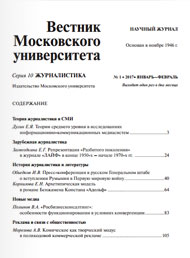
Content:
-
Media Economics
«Transformation of ownership structures on the Russian media market in the new economic conditions»
This article examines the restructuring of property relations in the Russian media market, caused by the general sanctions pressure on the country’s economy since 2022, as well as the mass refusal of foreign media companies to engage in most forms of business cooperation. A number of significant cases from various industry segments were examined: magazine and book publishing, pay television and content production, film distribution and online cinemas, music labels and audio streaming, and internet platforms. In each segment, the top five media companies with historical ties to foreign investors or offshore parent organizations were selected. The Rosstat database served as the empirical basis for the study, from which official data for 2021 and 2025 was used for comparison. This resulted in the updated composition of legal entities that have assumed the functions of owners or co-owners of Russian mass media. The author concluded that the changes that have occurred in the area of property management are systemic in nature, and that the domestic media business has effectively entered a new stage of development, relying much less on connections with partners abroad and the presence of structures in offshore jurisdictions.
Keywords: property ties, legal entity, founder, partner, offshore, legislation
DOI: 10.55959/ msu.vestnik.journ.6.2025.323Sergey S. Smirnov 3 -
«Independent audiovisual production companies as key actors on the modern audiovisual production market: a case study of the US, European, and Russian film industries»
This article is dedicated to the current state of film production markets in the USA, Europe, and Russia. Since the 1950s, the film industry in the USA and Europe has been influenced by socio-economic and cultural transformations; as a result, the classical vertically integrated studio system was gradually replaced by vertically disintegrated production networks comprising major studios, independent production companies, and specialized service providers. In Russia, the collapse of the studio system and the appearance of flexible production companies happened during the post-Soviet economic reforms in the early 1990s. Film production in Europe and in Russia is defined by protectionist policies and significant state funding of national products. The EU and the Council of Europe’s policy is mainly realized as coproduction, also involving several independent production studios. The flexible resource management inherent in the new film production system has helped lower costs and improve process efficiency. Independent production companies respond swiftly to shifts in demand, including in formats and genres, resulting in more diverse modern content. Flexibility and adaptability of independent production companies to the dynamic transformations of the media market have led to their predominance in the number of films and TV series produced in the USA, Europe, and Russia.
Keywords: independent audiovisual production companies, classical studio system of production, business model, film industry, organization of media production
DOI: 10.55959/msu.vestnik. journ.6.2025.2452Tatiana V. El-Bakri 24 -
Artificial Intelligence in Media and Communication Studies
«Unpacking public trust in AI-generated news: constructing and validating a three-factor measurement tool»
This methodological investigation sought to establish and validate the construct structure of a robust psychometric instrument for measuring public trust in AIgenerated news content, addressing a critical gap in digital media studies regarding the impact of automation. The research employed a sequential two-phase validation approach across two distinct, non-probability samples (N1= 850; N2= 900). In Study 1, Exploratory Factor Analysis (EFA) on an initial item pool identified a clear, three-factor configuration, which was subsequently streamlined and tested in Study 2 using Confirmatory Factor Analysis (CFA) on a 10-item scale. The confirmed dimensions were identified as: Trust in Content Reliability/Accuracy, Trust in Impartiality/Objectivity, and Risk Perception of Automation. The CFA model fit indices confirmed the dimensional fidelity of the instrument (x2/df=2.95; CFI=0.95; RMSEA=0.05), which also demonstrated exceptional reliability (α ≥0.79) and strong external evidence through anticipated correlations with media skepticism and technological awareness. Critically, the final scale successfully predicted key behavioral outcomes related to content adoption and sharing. Consequently, the validated Trust in AI News Scale offers a highly reliable and valid tool, essential for future analysis of socio-technical trust dynamics in automated journalism.
Keywords: automated news content, public trust, scale development, psychometrics, validity, reliability
DOI: 10.55959/msu.vestnik.journ.6.2025.5379Nacereddine Mazari 53 -
«Strategies for AI implementation in local newsrooms: typology and organizational context»
Thе study examines how Russian local newspapers adopt generative AI amid chronic resource shortages and institutional constraints. Drawing on 12 semistructured interviews with editors-in-chief from eight federal districts, it proposes a four-fold typology of AI strategies – enthusiasts, experimenters, observers and sceptics – and maps them onto Porter’s classic value chain. Automation is concentrated on “narrow” tasks (audio transcription, error correction, image generation), whereas strategic domains – data monitoring, fact-checking and UGC services – remain largely untouched. The decisive factor in AI uptake is not ownership form but dependence on budget contracts, entrenched business models and willingness to change newsroom culture. Paradoxically, the greatest automation potential lies in those value-chain stages where AI has not yet been deployed. The findings deepen understanding of local-press digital transformation and provide guidance for governmental and industry support of small newsrooms.
Keywords: AI, Russian journalism, local media, digital transformation, editorial policy, editorial strategies, value chain
DOI: 10.55959/msu.vestnik.journ.6.2025.80113Ekaterina A. Sinyakova 80 -
Modern Journalism: Subjects and Issues
«Evolution of Azerbaijan’s Coverage in Russian Media (2000–2024)»
The study analyzes the evolution of the coverage of Azerbaijani issues in Russian media from 2000 to 2024. Based on the analysis of 4,694 publications from leading Russian media using the Medialogia analytical platform, the author identifies key trends in media attention towards Azerbaijan. The results demonstrate a significant transformation in coverage approaches: a shift from predominantly economic topics to political issues, a rise in analytical genres, and a change in the tone of publications. The study reveals a correlation between coverage intensity and critical events in bilateral relations, confirmed by distinct peaks in publication activity during regional conflicts (2008, 2016, 2020, 2023). The obtained data reveal characteristic patterns of covering a post-Soviet country in Russian media, demonstrating the specifics of media representation of a state implementing a multivector foreign policy. However, extrapolating the identified patterns to other postSoviet states requires further comparative research, considering the specific bilateral relations of each country with Russia.
Keywords: Russian media, Azerbaijan, content analysis, bilateral relations, post-Soviet space
DOI: 10.55959/msu.vestnik.journ.6.2025.114139Anar M. Gasanov 114 -
Sociology of Journalism
«Understanding leadership in media: an industry professionals’ view»
This article explores how experts and media industry professionals conceptualize the characteristics of contemporary media leaders and the conditions under which leadership status is formed. The findings indicate that, despite the dynamic nature of the media environment and a high degree of uncertainty, there is little evidence of a distinct shift among current media leaders toward a “transformational” leadership type. In the perception of media professionals, the figure of a leader is only weakly associated with charismatic influence or the ability to inspire a team. These traits are not regarded as defining or critically essential for effective management. Leadership recognition often depends primarily on external circumstances. Increasingly, the most valued competencies include the ability to establish effective communication with all stakeholders – employees, partners, and investors – and to adapt swiftly to the changing conditions of the media industry. Key professional competencies are linked to the creation of relevant media content and its efficient dissemination. Among the main factors influencing the attainment of leadership status are professional achievements, recognition by audiences and the professional community, personal brand development, and systematic reputation management.
Keywords: media management, leadership, media leader characteristics, media, conditions for acquiring leadership status
DOI: 10.55959/msu.vestnik.journ.6.2025.140162Victoria V. Massan, Andrei V. Vyrkovsky 140 -
History of Journalism
«“From apolitical amateurism to conscious subordination to the tasks of socialist reconstruction”: the development of chess periodicals in the USSR in the 1920s»
This article examines the typological transformation of specialized chess press in the Soviet Union during the 1920s as an integral part of the physical culture and sports print media system of that period under the influence of key factors such as politicization, ideological orientation of the chess sphere, and centralization of publishing processes. The main stages and patterns of its development are identified, along with the reasons for changes and circumstances surrounding them, as well as the leading figures involved in chess journalism. Based on a comparative analysis of two primary groups of sources – publications from chess magazines of the 1920s and archival documents from the State Archive of the Russian Federation – the process is traced by which these publications evolved from narrowly specialized journals focused on intellectual leisure for a limited audience of chess enthusiasts into tools for engaging broad masses of athletes in cultural, political, and socio-economic state-building efforts.
Keywords: chess, physical culture, sports periodicals, chess journals, publishing activity
DOI: 10.55959/msu.vestnik.journ.6.2025.163194Konstantin A. Alexeev , Konstantin V. Silantiev 163 -
«I. A. Bunin – author of the column “Literature and press” in the newspaper “Orlovskiy vestnik” (1890)»
The article is devoted to one of the most urgent problems related to the study of Ivan Bunin’s early critical and journalistic creativity. The writer’s participation in the management of the column “Literature and Press” in the Orlovskiy Vestnik newspaper remains one of the blind spots in the biography of the writer: in particular, neither the timing of this participation nor the specific journalistic works that came from the pen of the young Bunin and published in “Literature and Press” are unknown. The time frame of the article is deliberately limited to 1890, since there is no information about Bunin’s participation in the column in other years. Due to the fact that the materials of the column were published without a signature, in order to identify Bunin texts, a special attribution procedure is required according to chronological, lexical-stylistic, ideological-thematic, historical-biographical criteria. Among the texts published in “Literature and Press”, reviews and notes are more amenable to attribution, to a lesser extent – informational messages and announcements written in a neutral or formal style. About attribution, the texts will be included in one of the volumes of Bunin’s first scientific “Complete collection”, in the “Dubia” section.
Keywords: Ivan Bunin, “Orlovskiy Vestnik”, “Literature and Press”, the Russian press of the late 19th century, newspaper genres, anonymous publications, attribution
DOI: 10.55959/ msu.vestnik.journ.6.2025.195215Anton V. Bakuntsev 195 -
«ROSTA activities in Crimea in 1919–1922»
The article deals with the history of the Russian Telegraph Agency (ROSTA) in Crimea – the Crimean regional branch KrymROSTA, its foundation and development during the first years of activity. The author examines the history of KrymROSTA during the Civil War and in the first years of Soviet power. The article shows the analysis of labor management, economy, and financial management aspects of the branch’s activities, indicators of its information agenda. As a conclusion, the work of KrymROSTA became one of the important factors in strengthening Soviet Power, forming the party-Soviet press system within the Crimean Peninsula. Alongside data activities, based on informing the center about events in Crimea and transmitting information from the center and the Crimean province to Crimean newspapers, the KrymROSTA agency was also engaged in agitation and propaganda work. The agency published a number of newsletters and bulletins on a rotary press, performed organizational and instructional functions, providing methodological assistance to the local press and supplying it with paper. It was also involved in the program to train journalists.
Keywords: history of journalism, Russian Telegraph Agency, ROSTA, KrymROSTA, Crimean journalism
DOI: 10.55959/msu.vestnik.journ.6.2025.216238Natalia V. Yablonovskaya 216 -
Materials, Documents, Publications
«On the 140th anniversary of I. S. Aksakov’s death. Correspondence between I. S. Aksakov and F. V. Chizhov»
The author introduces and comments on the previously unpublished correspondence between I. S. Aksakov and F. V. Chizhov, from the collections of the Russian State Library and the Institute of Russian Literature. The Chizhov collection contains 212 letters from Aksakov, while the St. Petersburg complex contains 44 letters and notes from Chizhov to Aksakov. The boundaries of the epistolary corpus itself, covering the years 1860–1877, are outlined. The value of the letters for researchers of the history of Slavophilism and post-reform Russia is substantiated: the correspondence re-veals the personal and business relationships of the correspondents, the mechanisms for supporting Aksakov in publishing and service projects, and also reflects current topics in public life (journalism, economic initiatives, internal circle discussions, responses to key domestic and international events of the era).
Keywords: I. S. Aksakov, F. V. Chizhov, slavophilism, epistolary heritage, correspondence, history of journalism
DOI: 10.55959/ msu.vestnik.journ.6.2025.239256Tatiana F. Pirozhkova 239